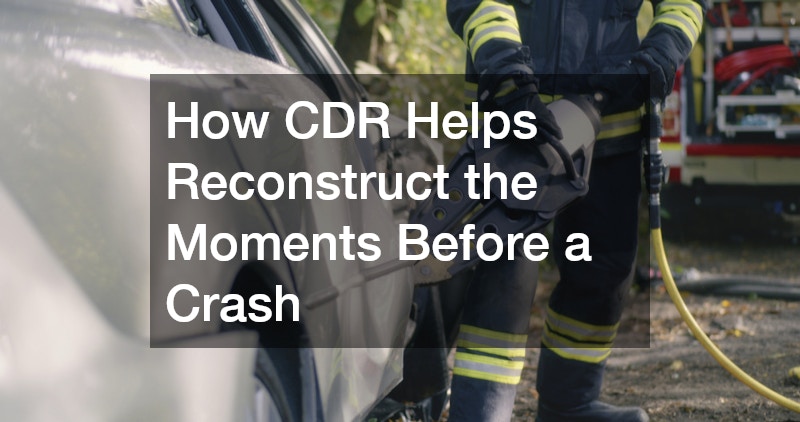
When a serious collision happens, understanding exactly what led up to the impact is often just as important as dealing with the aftermath. Modern vehicles contain advanced recording systems that can capture critical pre-crash information, and investigators often rely on a crash data retrieval service to access and interpret this data. This process, commonly referred to as CDR (Crash Data Retrieval), helps reconstruct the final seconds before a crash by analyzing electronic evidence stored within a vehicle’s control modules.
Video Source
Crash Data Retrieval refers to the process of downloading and analyzing data stored in a vehicle’s event data recorder (EDR). Most modern vehicles are equipped with these systems, which function similarly to a “black box” in an airplane. They continuously monitor and store information related to vehicle performance and driver behavior in the moments leading up to a collision.
When a crash occurs, the system may record data such as vehicle speed, throttle position, brake application, seatbelt usage, steering input, and airbag deployment timing. This data is preserved and can later be accessed using specialized tools designed to extract it safely without altering the original information.
CDR data is retrieved by connecting specialized diagnostic equipment to a vehicle’s onboard diagnostic port or directly to the airbag control module. Trained technicians use certified software to download the stored crash information. The process is non-destructive, meaning the vehicle’s systems are not damaged during retrieval.
Once the data is extracted, it is converted into a readable report that outlines the vehicle’s behavior in the seconds before, during, and sometimes after the crash. This report can include a timeline of events that helps investigators piece together what happened.
The amount of information stored in a vehicle’s event data recorder depends on the make, model, and year. However, most systems capture several key data points that are crucial for crash reconstruction.
Vehicle speed is one of the most important metrics, showing how fast the car was traveling in the moments before impact. Brake usage data indicates whether the driver attempted to slow down or stop. Throttle position reveals whether acceleration was occurring. Steering angle data helps determine directional movement and possible evasive actions.
Seatbelt status is also recorded, which can provide insight into occupant safety behavior. In some cases, airbag deployment timing and force levels are captured as well. Together, this information creates a detailed snapshot of vehicle activity leading up to the collision.
One of the biggest advantages of CDR technology is its ability to provide objective, time-stamped data. Unlike eyewitness accounts, which can be influenced by perception or memory, electronic data is not subjective. It allows investigators to reconstruct the sequence of events with greater accuracy.
For example, CDR data can help determine whether a driver was speeding before impact, whether braking occurred too late, or whether sudden steering changes contributed to the crash. It can also clarify conflicting accounts from drivers or witnesses.
In many investigations, this information is combined with physical evidence such as skid marks, vehicle damage patterns, and road conditions. When analyzed together, these elements create a comprehensive picture of how the crash occurred.
CDR data is often used in both legal and insurance contexts. In accident reconstruction cases, it can help establish fault by providing clear evidence of driver actions. Insurance companies may also use this data to verify claims and assess liability.
In some cases, CDR reports are used in court as expert evidence. Because the data is considered highly reliable, it can play a significant role in determining outcomes in disputed accident cases. However, interpretation of the data still requires trained professionals who understand both the technology and crash dynamics.
Crash Data Retrieval has become an essential tool in modern accident investigation. By capturing precise information from a vehicle’s internal systems, it allows investigators to reconstruct the moments leading up to a collision with a high level of accuracy. While it does not tell the entire story on its own, it provides a critical foundation for understanding how and why a crash occurred.
When combined with physical evidence and expert analysis, CDR data helps create a clear and objective view of events. This makes it an invaluable resource for improving accuracy in investigations, supporting legal cases, and ultimately helping bring clarity to complex crash scenarios.