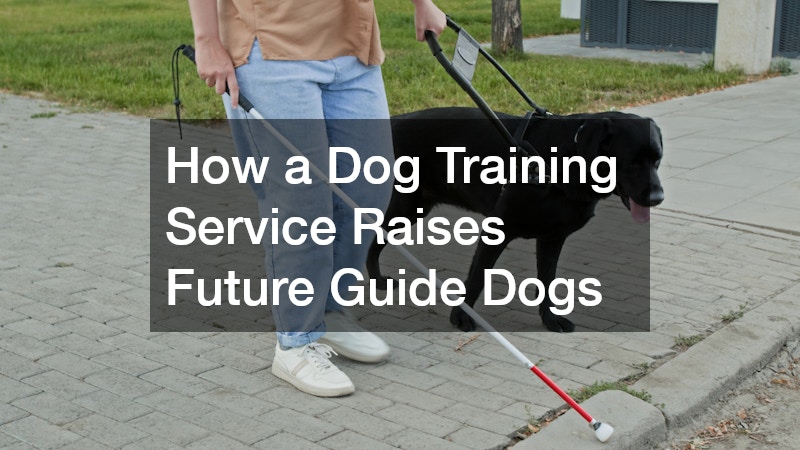
Raising a guide dog is a highly structured, deeply intentional process that blends behavioral science, patience, and consistency. Behind every confident, reliable guide dog is a carefully managed training journey that begins long before the dog ever meets its future handler. A professional dog training service plays a central role in shaping these animals into dependable companions capable of navigating complex environments.
The journey begins when puppies are just a few weeks old. At this stage, a dog trainer focuses on controlled exposure to a wide variety of environments, sounds, and people.
Video Source
This early socialization is critical because guide dogs must remain composed in situations that might overwhelm an untrained animal. Trainers introduce puppies to busy sidewalks, public transportation, and indoor spaces like stores and offices.
During this phase, the emphasis is not on complex commands but on shaping temperament. Puppies are encouraged to explore while learning basic boundaries. Positive reinforcement techniques help establish trust and engagement, which are essential for later training. The goal is to cultivate a calm, attentive demeanor that allows the dog to process its surroundings without distraction.
Basic obedience is gradually introduced alongside socialization. Commands such as sit, stay, and come are reinforced consistently. These foundational behaviors serve as the building blocks for more advanced tasks. A reliable response to these cues ensures that the dog can be guided and corrected efficiently as training becomes more demanding.
Equally important is the development of focus. Trainers work to minimize impulsive reactions, teaching the dog to ignore distractions such as food on the ground or other animals. This level of discipline is crucial for a future guide dog, which must prioritize the safety and direction of its handler above all else.
Once the dog has mastered basic obedience and demonstrated a stable temperament, training progresses into more specialized skills. At this stage, a dog training service begins teaching the tasks that define a guide dog’s role. These include navigating obstacles, stopping at curbs, and identifying safe paths through crowded or unpredictable environments.
One of the most critical skills is intelligent disobedience. This concept requires the dog to override a handler’s command if it would lead to danger. For example, if instructed to move forward into traffic, a properly trained guide dog must refuse. Teaching this behavior involves carefully designed scenarios where the dog learns to assess risk independently while still respecting its handler’s authority.
Trainers also focus on directional commands such as left, right, and forward. The dog learns to respond accurately while maintaining awareness of obstacles and changes in terrain. Repetition and consistency are key, as these commands must become second nature under a wide range of conditions.
Environmental complexity increases throughout this phase. Dogs are exposed to urban settings, varying weather conditions, and high-distraction areas. Each new challenge reinforces adaptability and resilience. The dog trainer ensures that progress is measured and that each dog meets strict performance benchmarks before advancing.
The final stage of the process involves pairing the trained dog with a suitable handler. This step is far more nuanced than simply matching availability. Trainers consider factors such as walking speed, lifestyle, and personality to ensure compatibility. A successful match enhances both safety and quality of life for the handler.
Before placement, the dog undergoes rigorous evaluation. Trainers assess consistency, reliability, and decision-making in real-world scenarios. Any hesitation or inconsistency is addressed through additional training. The goal is to ensure that the dog can perform its duties with minimal error, even in unfamiliar environments.
Once matched, the handler and dog complete a joint training program. This allows the handler to learn how to communicate effectively with the dog while reinforcing previously learned skills. The transition period is essential for building trust and establishing a strong working relationship.
Even after placement, support continues. Many organizations and training providers offer follow-up sessions and ongoing guidance to ensure long-term success. A reputable dog trainer understands that maintaining a guide dog’s performance requires periodic reinforcement and adaptation as circumstances change.
Training a guide dog is a meticulous process that demands expertise, patience, and a structured approach. From early socialization to advanced task execution, each stage is designed to produce a dog that is both dependable and intuitive. The role of a dog training service is central to this transformation, ensuring that every dog meets the high standards required for such an important responsibility.